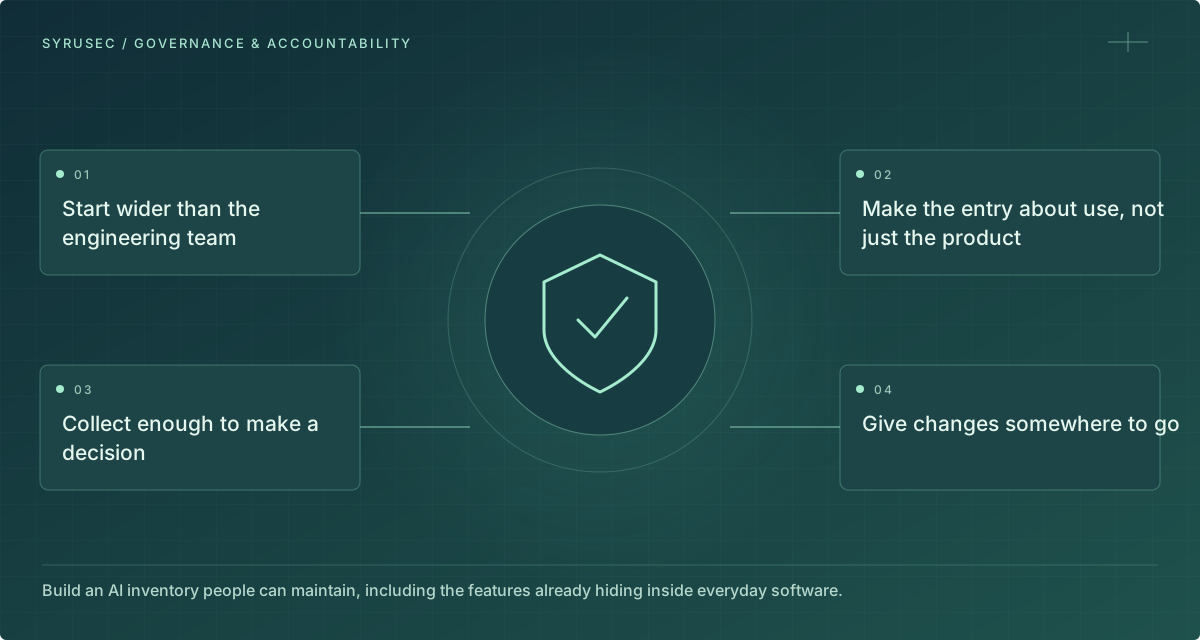
Governance & accountability
You cannot govern the AI you cannot see.
Build an AI inventory people can maintain, including the features already hiding inside everyday software.
Read and explore ↗ SyruSecAI GOVERNANCE · RISK · SECURITY
AN INDEPENDENT LEARNING SPACE
AI governance, risk, compliance, and security—explained with care, connected to real work.
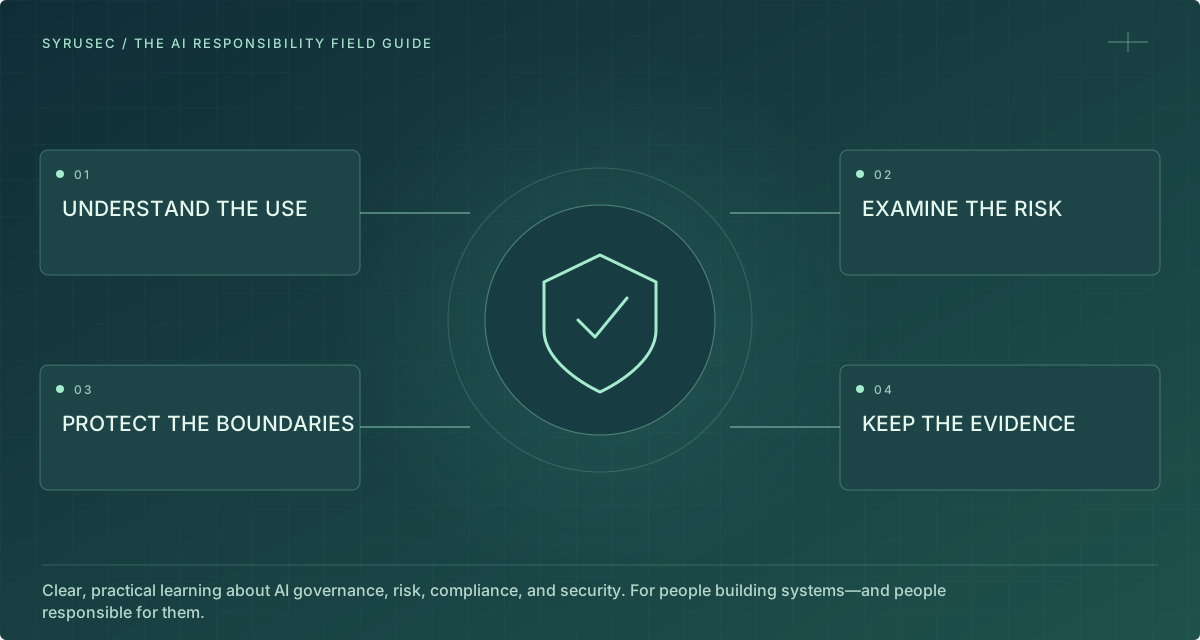
What would we need to know
before trusting this system?
Start with a question. Follow the evidence.
Leave with something you can put into practice.
SIX CONNECTED FIELDS
You can enter anywhere.
The ideas connect as you go.
Models, applications, agents, and the real decisions around them.
02 / Make ownership clearGive policies, oversight, and organizational decisions a practical home.
03 / Turn uncertainty into decisionsUnderstand potential harms, choose proportionate responses, and track what remains.
04 / Protect the boundariesExplore prompt injection, retrieval permissions, agents, and AI-enabled attacks.
05 / Know what each source meansSeparate legal obligations, voluntary frameworks, management systems, and technical requirements.
06 / Find evidence you can trustUse evaluations, adversarial tests, and incident practice to examine how a system behaves.
GOOD PLACES TO BEGIN
Governance & accountability
Build an AI inventory people can maintain, including the features already hiding inside everyday software.
Read and explore ↗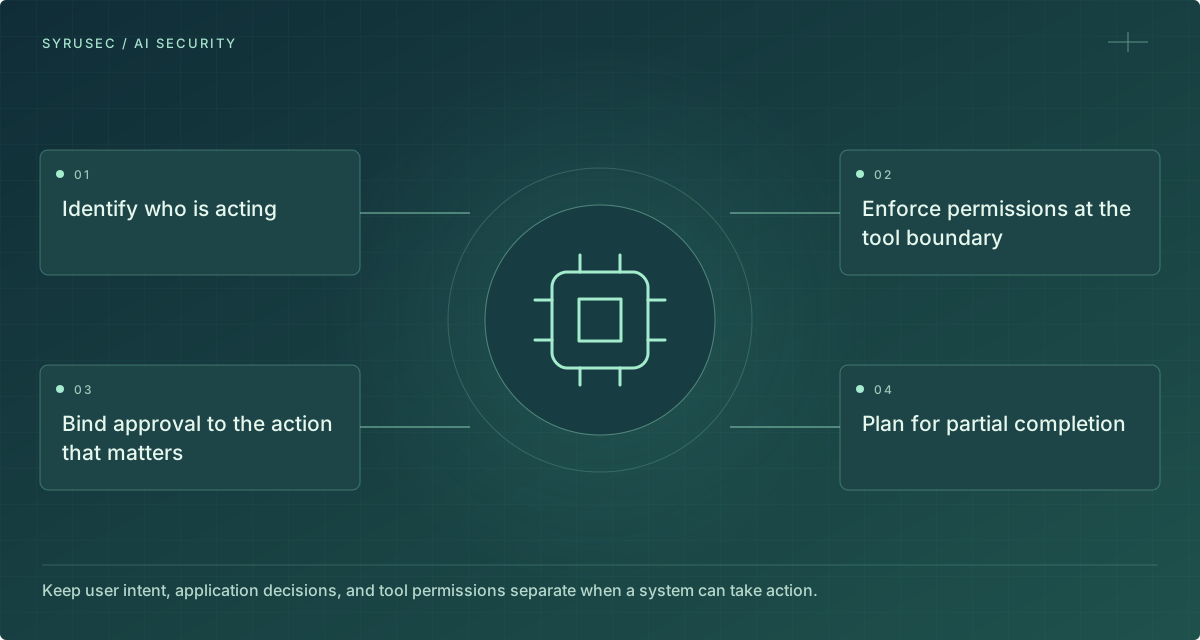
AI security
Keep user intent, application decisions, and tool permissions separate when a system can take action.
Read and explore ↗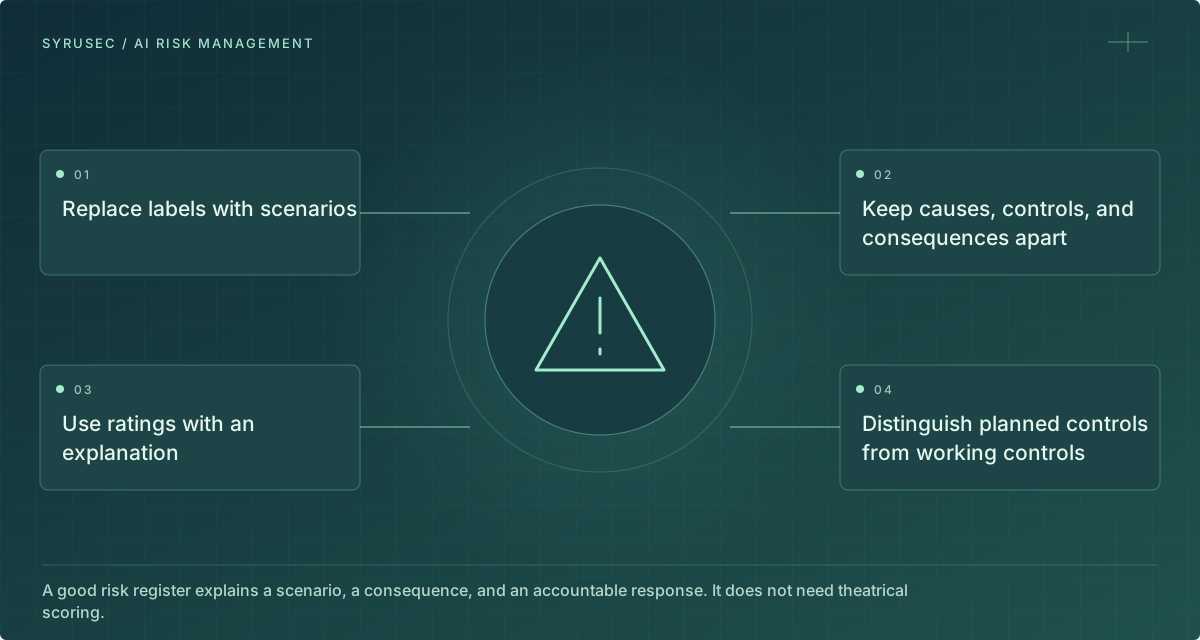
AI risk management
A good risk register explains a scenario, a consequence, and an accountable response. It does not need theatrical scoring.
Read and explore ↗LEARN FROM WHAT HAPPENED
Explore documented incidents, AI-enabled attacks, and research demonstrations from 2023–2026. See what the evidence supports, what remains uncertain, and which lesson belongs in your own review.
Explore the incident timeline ↗What actually happened?
Who reported it, and what are the limits?
Which boundary should we test?
FROM RISK TO EVIDENCE
A company introduces an assistant that can read internal files and submit requests. Follow the data, identify the permissions, write a risk scenario, and decide what evidence would support release.
Open the practical toolkit ↗LEARN FROM THE ORIGINALS
Our source guides explain what each organization’s material is for, when to use it, and what it does not establish.
Meet the source library ↗TURN CURIOSITY INTO A LEARNING PATH
Compare current AI courses and certifications, understand the starting points, and build a small project that connects platform knowledge to responsible operation.