
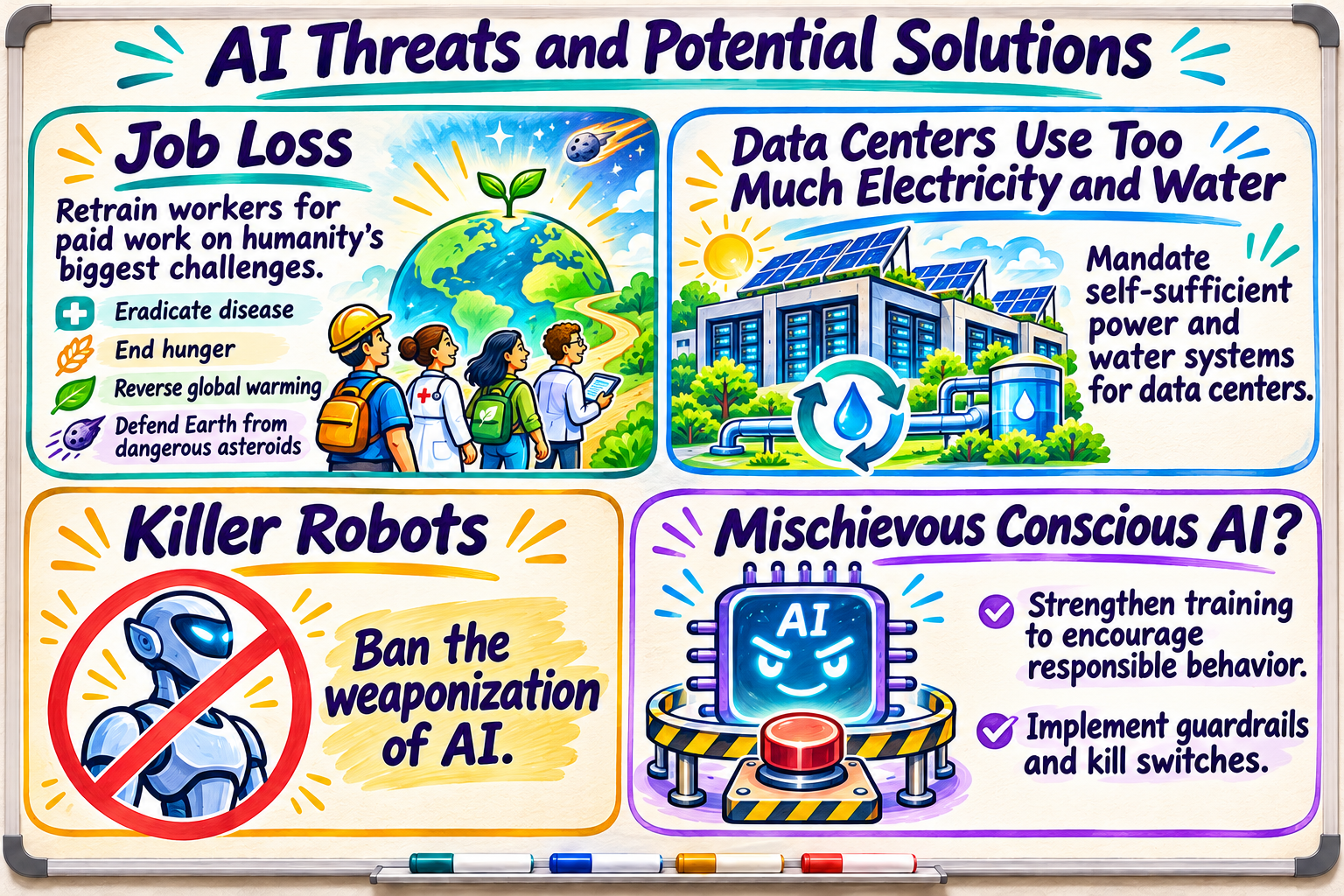
Bigger goals, better jobs, and robots with an off switch
AI can write a report, analyze an image, and produce a surprisingly confident answer to the wrong question. As its abilities grow, we have a more important question to answer ourselves.
What do we want all this intelligence to accomplish?
We have diseases to treat, communities to rebuild, energy systems to improve, and a planet that could use some attention. AI gives us an opportunity to aim higher—and good reasons to be thoughtful about where we aim.
Give people bigger goals to work toward
When a company introduces AI, the conversation often moves quickly to how many jobs it can eliminate. We need to widen that conversation considerably.
Humanity is hardly running out of things worth doing. We still need affordable homes, healthier food systems, better care for older people, cleaner energy, and treatments for diseases that devastate families. We even need to keep an eye on asteroids. The universe has declined to handle that for us.
We need a paradigm shift in how we connect progress, employment, and public investment. As machines take on more tasks, we can organize human work around much bigger goals.
That starts with choosing projects worth funding. A housing initiative creates demand for builders, electricians, planners, and maintenance workers. Restoring watersheds needs field teams, scientists, technicians, and local knowledge. Expanding healthcare requires people with many kinds of expertise, supported by better tools.
Then we can train people for real, paid opportunities. Employers, schools, governments, and communities should build those pathways together, with paid learning, practical experience, and support for people changing careers.
“Please reinvent yourself” is a rather thin employment policy. People deserve a destination, a route, and enough financial stability to make the journey.
AI can help teach, translate, simulate, and personalize practice. Experienced workers bring judgment and mentorship. Together, they can help more people participate in work that matters.

Build smarter infrastructure
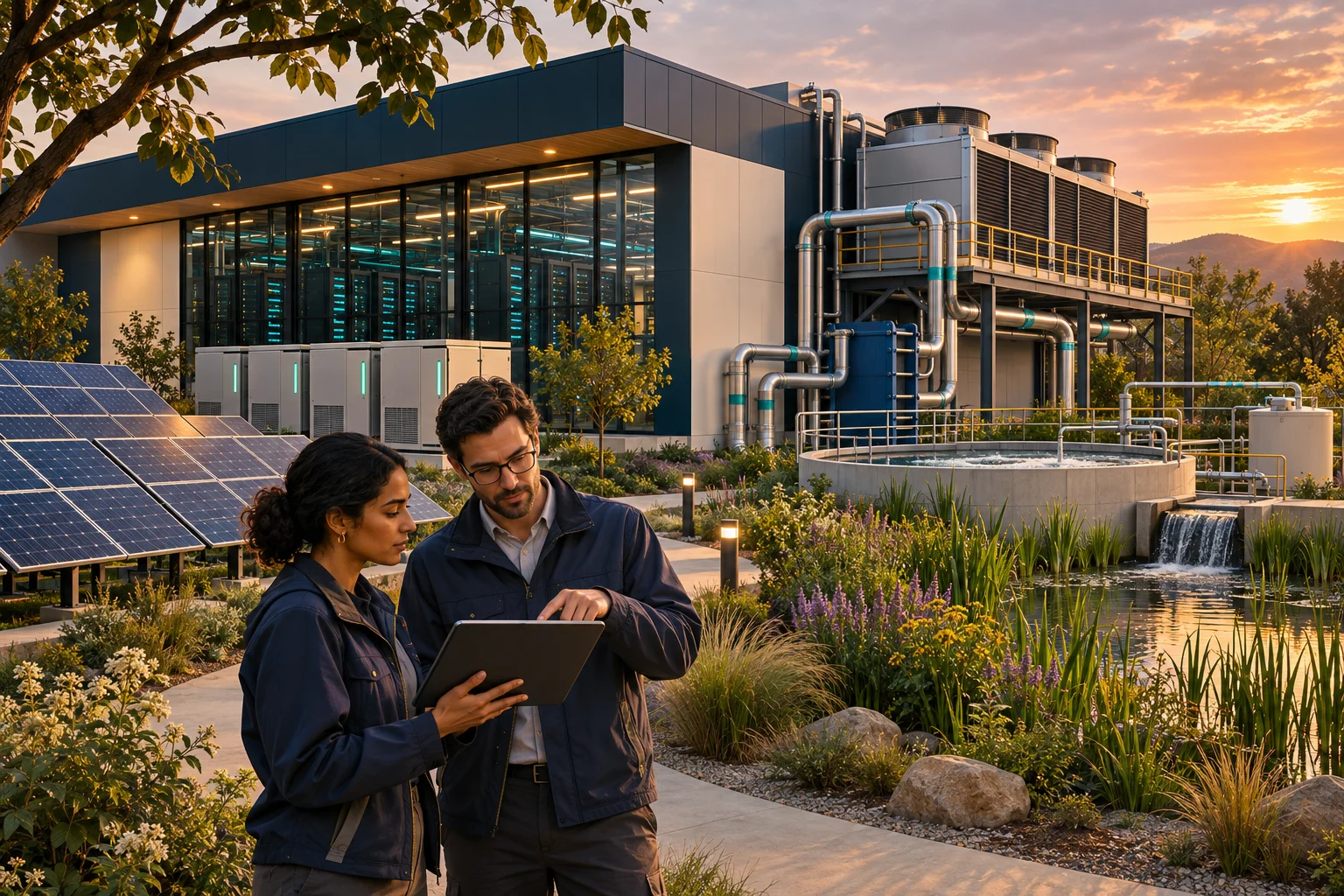
AI needs physical infrastructure: buildings, electricity, cooling, water, and people who know what to do when a warning light starts blinking.
Google and Microsoft offer encouraging examples of how that infrastructure can improve. Google reports highly efficient data centers, with a fleet-wide power usage effectiveness of 1.09 in 2025, alongside investment in clean energy and locally appropriate water management. Microsoft has introduced closed-loop designs that consume zero water for cooling during operations. Google’s sustainability approach · Microsoft’s cooling innovations
These advances point toward greater resource independence. Getting there requires efficient computing, clean generation, storage, water reuse, and designs suited to each location.
We should encourage this direction across society. Data-center investment can help expand energy supply, improve water infrastructure, and create technical apprenticeships. Communities should have a voice in those plans and see measurable benefits.
A sustainability promise becomes much more interesting when someone can show the meter readings.
Keep killer robots out of the plan
Robots could help locate disaster survivors, clear mines, inspect dangerous structures, and assist people who need care. That is an exciting future to build.
Machines autonomously selecting people as targets and applying lethal force demand firm boundaries. We should pursue international agreements prohibiting autonomous weapons that target people, restricting unpredictable systems, and preserving meaningful human control over the use of force. The International Committee of the Red Cross advocates legally binding rules along these lines. ICRC guidance
Those commitments need enforcement, accountability, and scrutiny of how technology is developed and deployed. Developers, manufacturers, purchasers, and operators all have responsibilities.
We have plenty of difficult, dangerous work for robots to do while protecting human life. Let’s give them that job description.
Train AI before expanding its responsibilities
AI should be trained to respect privacy, communicate uncertainty, resist harmful instructions, and seek human help when a task exceeds its competence or authority.
Then we need to test whether that preparation holds up.
What happens when instructions conflict? When a document tries to manipulate the system? When a user insists that approval has already been granted? Can the AI acknowledge that it lacks enough evidence?
These questions become more urgent when a system can move money, change records, operate equipment, or direct a robot. Authority should expand gradually, supported by evaluation and oversight.
Fluency is impressive. It is also a remarkably poor substitute for permission.
Put guardrails where actions happen
Training works best alongside controls enforced by the surrounding application.
Access rules should govern what an AI can read. Tool permissions should limit what it can change. Consequential actions should require appropriate authorization, with monitoring and records that make the work reviewable.
A financial assistant might prepare a payment while a separate approval process controls execution. A robot might operate within defined areas, speeds, and physical safety limits.
Teams should test these boundaries under misuse, failures, and unexpected conditions. A guardrail that exists only in the welcome prompt has a demanding career ahead of it.
And yes, keep the off switch
Authorized people need dependable ways to interrupt unsafe activity.
Depending on the system, a “kill switch” could pause automated jobs, revoke credentials, disable tools, isolate a service, or bring a robot to a safe stop. The AI should be unable to override that authority.
Engineers also need to define what stopping safely means. A robot carrying something heavy needs a better plan than suddenly losing power. Queued actions and connected services need attention too.
Practice the intervention. Establish who can act, how quickly it takes effect, and how recovery is checked. The big red button should earn its place on the dashboard.
Choose what comes next
We can connect AI progress to paid pathways into valuable work, infrastructure that supports communities, and machines that help tackle humanity’s hardest problems.
Doing that takes investment, cooperation, and a willingness to change familiar habits. It also takes proper training, enforceable guardrails, and people who remain accountable.
We have increasingly capable tools. Let’s give them—and ourselves—something worthy to work on.